



52% of Gen Z professionals intentionally avoid management roles, a trend known as “conscious unbossing”.
Faced with this reality, Luxembourg companies must adapt their organisational models to avoid finding themselves short of future leaders.
Luxembourg, where Gen Z makes up a growing proportion of a highly internationalised workforce, is not immune to this generational paradigm shift.
Long regarded as the necessary stepping stone to professional success, the role of middle manager is losing its appeal among younger generations. This phenomenon, documented on an international scale, takes on a particular dimension in Luxembourg, where Gen Z already accounts for 27% of the workforce within OECD member countries, and where projections indicate youth employment growth exceeding the EU average, with an annual increase of over 1.5% until 2035 according to the European Centre for the Development of Vocational Training.
According to a study conducted by Robert Walters among 3,600 Gen Z professionals, more than half of them express their refusal to become middle managers, as part of a movement now dubbed ‘conscious unbossing’. This term, which has become established in the international HR debate, refers to young professionals consciously and deliberately avoiding positions of hierarchical responsibility, not due to a lack of ambition, but as a result of a considered career choice.
According to the same survey, 69% of Gen Z respondents do not want a managerial role because such positions are both too stressful and not sufficiently rewarding, whilst 72% say they prefer to focus on an individual career path centred on skills development and personal growth.
This disenchantment did not arise out of nowhere. Since the Covid-19 pandemic, there has been greater openness within companies, particularly among managers who are more vocal about their difficulties. According to a survey conducted in France by UKG’s Workforce Institute, managers are on average more anxious than their teams, with 25% of them stating that they often, or even constantly, feel exhausted. For Gen Z, this visible and well-documented reality makes management roles unattractive, especially as the pay gap does not always compensate for the overload of responsibilities. According to a Capterra study, 75% of middle managers feel overwhelmed, stressed and sometimes close to burnout.
"Young people are no less committed; they are simply committed in a different way", Manuelle Malot, Director of EDHEC’s NewGen Talent Centre
In an article by EDHEC’s NewGen Talent Centre (NGTC), drawing on the testimonies of 2,000 former students from business and engineering schools, more than nine out of ten young people expect their managers to trust them and give them autonomy, or to protect them and stand up for their team. Its director, Manuelle Malot, sums it up as follows: “Young people are no less committed; they are simply committed in a different way.” This crucial distinction challenges us to move beyond facile generalisations about a generation reputed to be lazy or disengaged.
The motivations driving Gen Z to shun management roles are varied and revolve around three main themes.
The first is well-being and mental health. According to the consultancy Empreinte Humaine, around 41% of French employees suffer from psychological distress at work, and for Gen Z, preserving their mental health and ensuring a work-life balance is paramount. It is therefore only natural that they are turning away from roles with greater responsibility. This generation, which has grown up amidst a succession of crises—health, economic and climate—is particularly vigilant about its own well-being and refuses to sacrifice it for the sake of a hierarchical title.
The second theme is the redefinition of success. Lucy Bisset, Director at Robert Walters North, highlights that Gen Z is known for its entrepreneurial spirit, preferring to add value to projects and devote time to cultivating their own brand and approach, rather than spending time managing others. For this generation, career progression no longer necessarily involves climbing the corporate ladder, but rather the accumulation of expertise, building a personal reputation and diversifying experiences.
Finally, the third key theme is a distrust of the traditional managerial structure itself. Members of Gen Z want to see the company’s values embodied in everyday life, at all levels of the hierarchy, and a manager who preaches work-life balance but sends emails at 10 pm will immediately lose credibility, points out Sandrine Lardeux, a career assessment coach and former HR professional, interviewed by the Asensile website. This perceived disconnect between managerial rhetoric and lived reality acts as a powerful deterrent for young professionals who place authenticity at the heart of their criteria for commitment.
‘Conscious unbossing’ is not limited to the UK, where the Robert Walters study was conducted. In Germany, according to Academic Work’s Young Professional Attraction Index, fewer than a third of the young professionals surveyed express a genuine desire to become a manager or team leader. Young people from Generation Z are showing a growing disinterest in management or leadership roles, driven in particular by a fear of responsibility and the pursuit of a work-life balance. In Switzerland, data from Robert Walters shows that 42% of Gen Z professionals do not wish to become middle managers, and that 74% prefer autonomy to a leadership role.
In Luxembourg, this debate takes place against the backdrop of a unique labour market. According to Randstad’s Workmonitor 2024, 40% of Gen Z members do not feel understood by their employer in the Grand Duchy. This mutual lack of understanding is being taken seriously by local HR departments. Christopher Frères, of the Luxembourg Stock Exchange, acknowledges that this generation is “redefining expectations” and that this “is driving us to adapt our communication and management styles, whilst rethinking career paths to better meet their aspirations, which are emerging at an ever-faster pace”.
For her part, Myriam Sibenaler, HR Director at the ABBL, emphasises that Gen Z “seeks, above all, meaning in their work, genuine flexibility to balance professional and personal life, as well as sincere recognition of their efforts”, and that “these demands, far from being a challenge, are an opportunity for companies to rethink their practices and create more humane, inclusive and inspiring work environments ”.
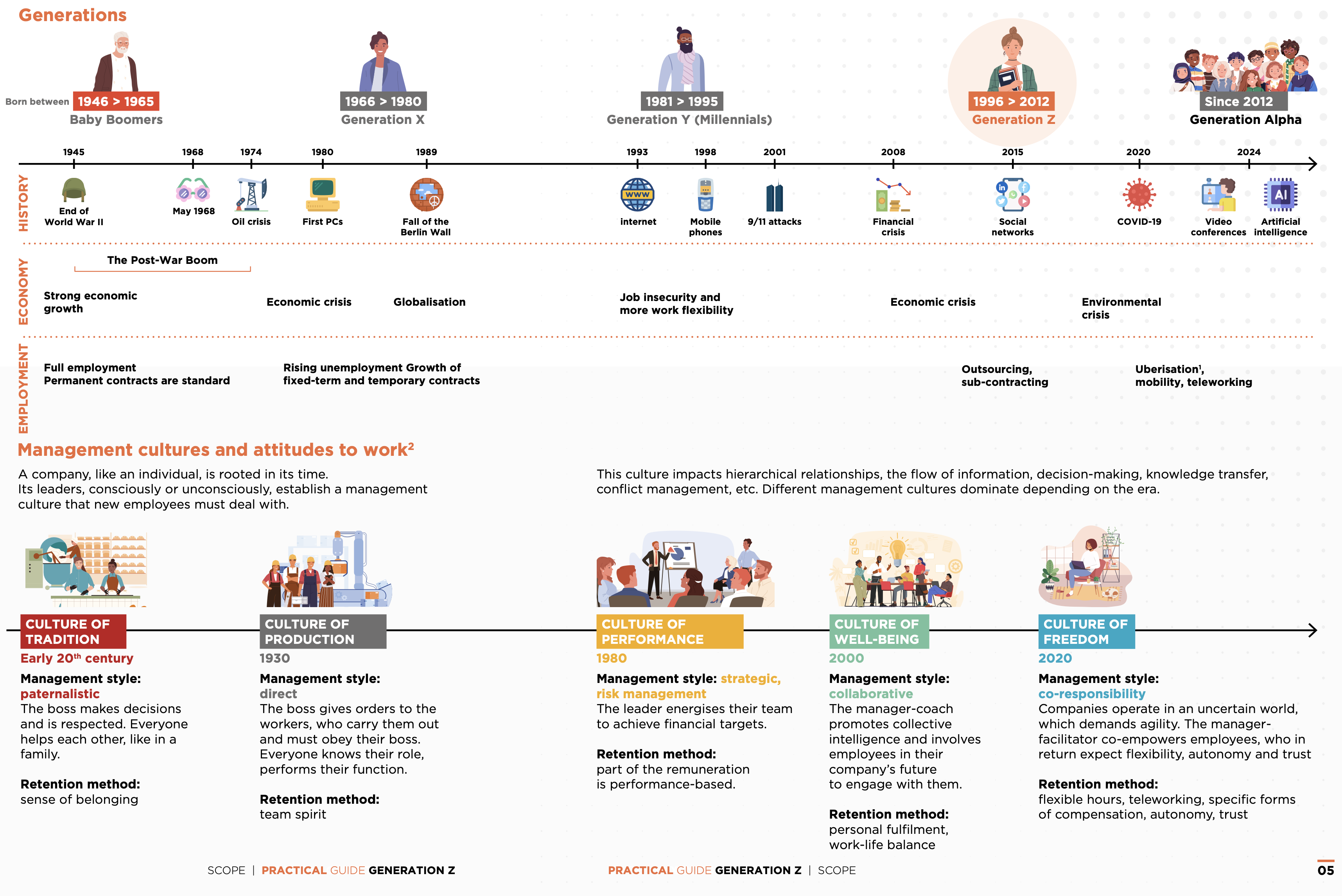
The Luxembourg Chamber of Commerce has also published a Practical Guide dedicated to Gen Z, aimed at HR managers, line managers and executives, placing particular emphasis on developing attractive recruitment methods and the importance of modern management practices that are better aligned with this generation’s expectations.
Job vacancies for candidates with less than two years’ experience have fallen by 29% since January 2024, according to a study by the Randstad Group, which further complicates the integration of young Luxembourgers into a highly competitive market. In this challenging climate, companies that fail to offer attractive career paths other than the traditional managerial route risk losing their best junior talent to more agile organisations.

Despite the scale of the phenomenon, the reality offers a more nuanced picture: 36% of respondents to the Robert Walters survey expect to have to take on a managerial role at some point in their career, even if they do not wish to. This figure highlights a tension between stated aspirations and the reality of organisational structures, where opportunities for progression are often contingent on taking charge of a team. In this context, Lucy Bisset, Director at Robert Walters North, calls for enhanced manager training, noting that three-fifths of British managers have received no formal management training.
For Luxembourg companies, several avenues are opening up to respond to this shift. The first involves diversifying internal progression pathways by creating specialist or technical lead roles that allow staff to take on greater responsibility without necessarily managing teams.
The second lies in transforming the role of the manager themselves: the manager of tomorrow could be more of a coach or mentor who helps their staff become more independent and take the initiative, whilst continuing to carry out the operational tasks they enjoy.
The third approach concerns managerial culture: the 80% of HR professionals who say they lack confidence in their leadership pipelines are encouraged to innovate by offering flexible career paths, mentoring rather than micromanagement, and a focus on well-being to make leadership roles more attractive.
Only 14% of workers born between 1995 and 2012 believe that the traditional hierarchical structure is still relevant, and 30% would opt for a horizontal, team-centred organisational structure. This strong signal urges Luxembourg HR directors to anticipate a structural transformation that will only accelerate as Gen Z takes up an increasing share of the workforce. According to data from Glassdoor, this generation already accounted for 10% of managers in the first half of 2025, a proportion set to exceed that of baby boomers in management roles by the end of 2026.
The phenomenon of ‘conscious unbossing’ is not a generational whim, but a symptom of a profound transformation in attitudes towards work and authority. For Luxembourg companies, operating in a multicultural, cross-border labour market where many roles are under pressure, the question is no longer whether they must adapt, but how quickly.
Rethinking career paths, reinventing the role of the manager, and valuing individual expertise on a par with hierarchical leadership: these are the urgent tasks facing HR departments in the Grand Duchy to turn this generational challenge into a sustainable organisational opportunity.



.jpg)
.jpg)
.jpg)